Overview of X-ray Camera SUIM
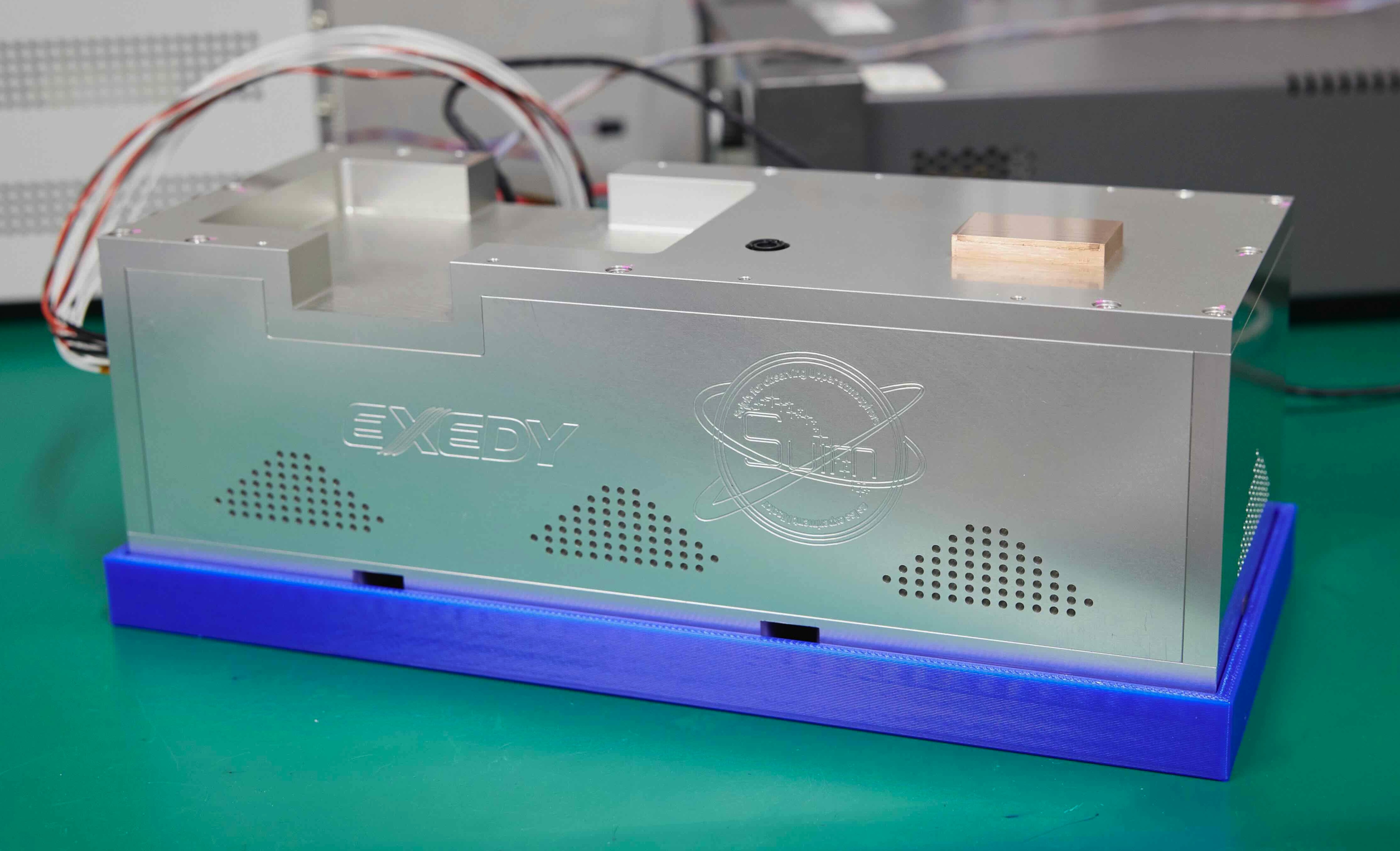
SUIM is an X-ray camera developed to observe the upper atmosphere at around an altitude of 100 km. It is planned to be mounted for six months on MISSE, an external experiment platform on the International Space Station (ISS) operated by the U.S. company Aegis Aerospace, and to conduct observations pointing toward the Earth horizon. SUIM is equipped with XRPIX, a proprietary X-ray SOI-CMOS pixel detector co-developed by Kindai University, University of Miyazaki, Kyoto University, Tokyo University of Science, and others. XRPIX is a type of SOIPIX (silicon-on-insulator pixel) image sensor that uses SOI (silicon-on-insulator) technology and is characterized by high X-ray sensitivity even at room temperature. This project will be the first on-orbit demonstration of XRPIX. The housing and slit collimator were manufactured by EXEDY Corporation, a joint research partner of Kindai University. SUIM is scheduled to be launched in 2026 and returned to Earth after the six-month operation period. By evaluating the performance of XRPIX after exposure to the space environment, we will apply the results to the development of next-generation X-ray astronomy cameras.
Method
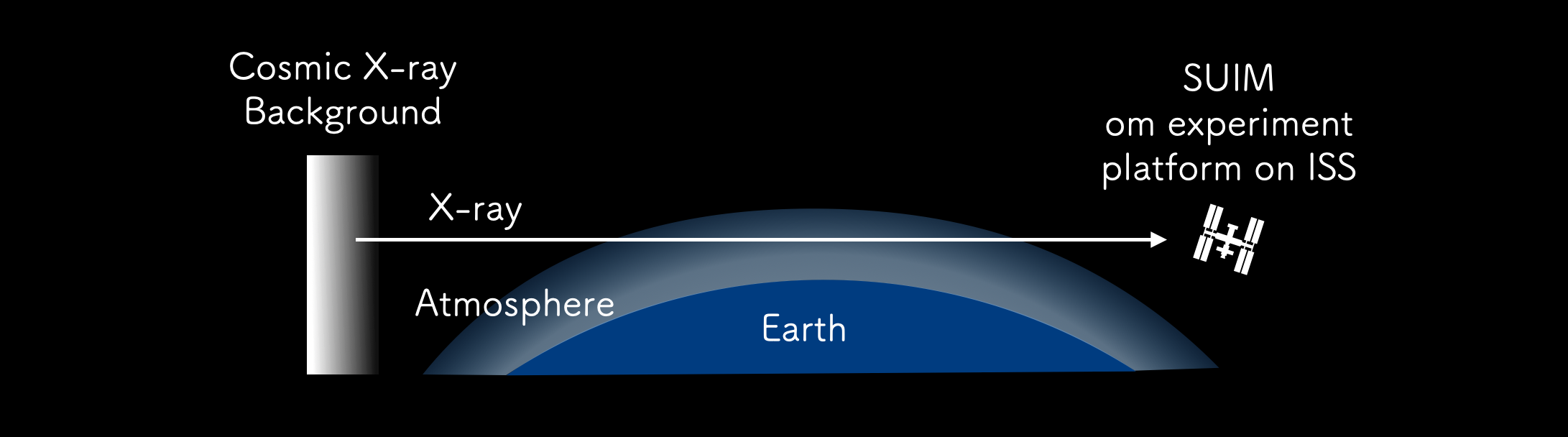
The upper atmosphere at around an altitude of 100 km, which SUIM targets, has long been a data-sparse region because “in situ” measurements with balloons or satellites are difficult. Under these circumstances, a method to observe the upper atmosphere using X-ray astronomy satellites has been demonstrated (1, 2). When an X-ray astronomy satellite observes celestial objects while orbiting the Earth, the target can occasionally be temporarily occulted by the Earth. Immediately before and after such an occultation, X-rays from the source are absorbed and scattered by the Earth’s atmosphere, causing the observed intensity to decrease. The atmospheric density can be derived from this intensity decrease—much like taking an “X-ray radiograph” of the atmosphere.
SUIM is a dedicated X-ray camera designed to exploit this method and to continuously measure atmospheric density. SUIM points its X-ray camera toward the Earth’s horizon (limb) and continuously observes the cosmic X-ray background—X-ray emission arriving from all directions in the Universe—after it has passed through the Earth’s atmosphere. Because the intensity of the cosmic X-ray background is well known, the atmospheric density can be determined from the observed attenuation.
Specifications
| Dimensions: | 290 x 120 x 91 mm2 |
| Mass: | 3.3 kg |
| Power: | 7.3 W (average) |
| Downlink volume: | 1 GB/week for the first 4 weeks; 7 GB/month for the remainder of the mission (max) |
| Instruments: | Slit collimator + X-ray SOI-CMOS pixel detectors (XRPIX; two sensors) |
| Visible-light CMOS camera (one unit) | |
| Launch: | SpaceX CRS-34, May 15, 2026 at 22:05:41 UTC |
| Host platform: | MISSE-22 |
Name and Logo
“SUIM” is an acronym for “Soipix for observing Upper atmosphere as ISS experiment Mission.” The name was inspired by the fact that the upper atmosphere around an altitude of 100 km—the target of SUIM—emits a greenish airglow. In addition, it was named in reference to Kindai University’s achievement as the first in the world to succeed in the complete aquaculture of bluefin tuna, with the hope that SUIM will play an active role as if it were “swimming” through space.
The SUIM logo was jointly designed by students from the Physics Course (Department of Science, Faculty of Science and Engineering) in Associate Professor Kumiko Nobukawa’s laboratory and students from the Department of Cultural Design (Faculty of Literature, Arts and Cultural Studies) in Professor Tetsuya Goto’s laboratory. Among several proposals, the design by Tomoe Nishido was selected. The chain of stars symbolizes both the SUIM concept—observing the atmosphere using X-rays arriving from celestial objects—and the observational data obtained through the mission, while the green curve represents the orbit of the International Space Station around the Earth as well as the green airglow.